Key Topics
Leading the New Global Trend Toward Carbon Neutrality and Shaping a Low- Carbon Future with CCUS
CCUS is a key technology for reducing carbon emissions and is widely regarded as a key enabler of carbon neutrality. In October 2021, during an inspection visit to Shengli Oilfield, General Secretary Xi Jinping was briefed on the field's CCUS implementation and progress in research and application, and highlighted the importance of pooling resources to achieve breakthroughs in core technologies across key sectors, accelerating the clean and efficient development and use of energy, and improving energy supply quality, utilization efficiency, and carbon reduction performance. In 2024, on the 75th anniversary of the founding of the People's Republic of China and the 4th anniversary of China's pledge to peak carbon emissions by 2030 and achieve carbon neutrality by 2060, General Secretary Xi Jinping sent a message of encouragement to Sinopec's project team. He reaffirmed his recognition of its efforts and provided important guidance, offering a clearer direction for green and low-carbon development. In response, Sinopec has kept key directives firmly in mind, forging ahead with gratitude. The Company has since worked to deliver high-quality CCUS outcomes through practical efforts, while exploring new pathways for carbon reduction and storage that give equal emphasis to green and low-carbon transformation and development.
"Carbon in, oil out": Turning Emissions into Value
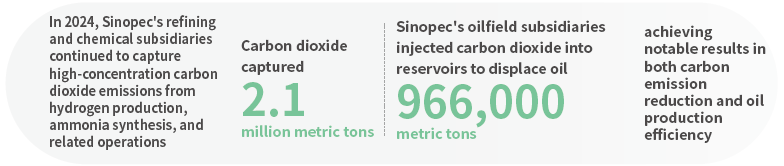
CCUS represents a critical technology for the energy and chemical industry to achieve carbon peaking and carbon neutrality goals. Unlike water in a cup, underground oil is not always found in one single pool but is instead dispersed within the microscopic pores of rock formations. Therefore, extracting it is much like squeezing oil from rocks. During oil extraction, water is typically injected into reservoirs to displace oil from rock pores. However, in low-permeability reservoirs, the pores are too small for water to enter easily, requiring extremely high pressure and making extraction particularly difficult. However, in its supercritical state, carbon dioxide has a lower viscosity than water and is better able to penetrate these pores. Acting like a solvent, it enhances the mobility of viscous crude oil, enabling greater oil extraction efficiency. CCUS technology captures carbon dioxide emitted from industrial activities and energy consumption. The gas is then separated, purified, and transported to designated sites via pipelines, tank trucks, or other means for use or storage. When injected into oil reservoirs, carbon dioxide not only significantly improves oil recovery rates but also remains permanently underground, achieving the dual objectives of reducing carbon emissions and increasing oil production.
A New Trail for CCUS: Establishing an Industrial Demonstration Project
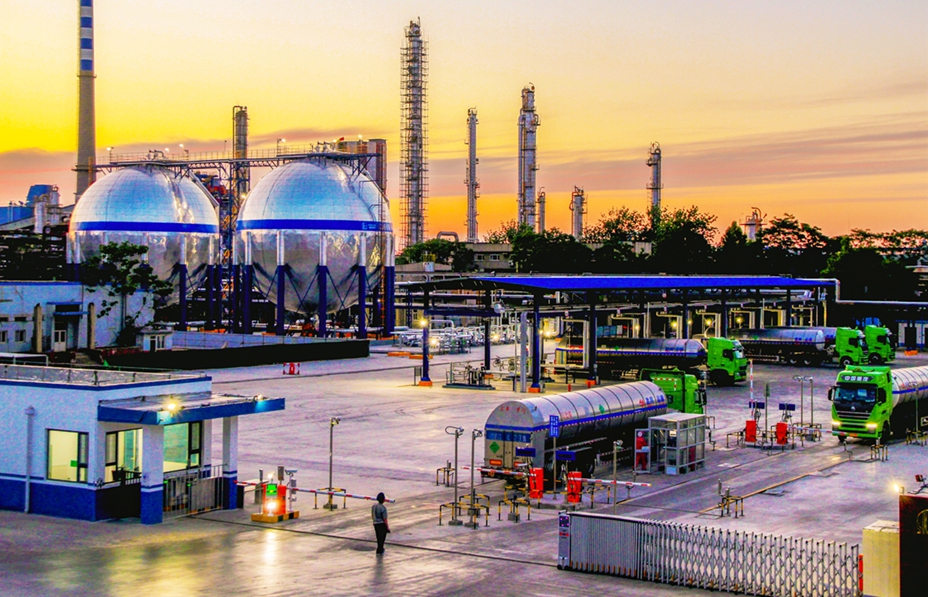
Sinopec's Qilu-Shengli Oilfield Million-Ton CCUS Project is China's first CCUS initiative at the million-metric-ton scale, with the capacity to capture and store 1 million metric tons of carbon dioxide each year. This is roughly equivalent to planting 9 million trees or taking approximately 600,000 economy cars off the road for a year. The project marks a major step forward in advancing the development of the "artificial carbon cycle" model and strengthening China's carbon reduction capabilities. It also serves as an engineering benchmark, providing valuable experience and technical insights to support the large-scale rollout of CCUS initiatives nationwide. By the end of 2024, the Gao 89-Fan 142 demonstration site had injected over 1 million metric tons of carbon dioxide, achieved mixed-phase conditions across 8 blocks, and increased daily oil production from 220 to 442 metric tons, delivering on its dual objectives of reducing carbon emissions and increasing oil production.
The project is supported by the construction of a 109-kilometer carbon dioxide pipeline, which is the first large-scale carbon dioxide transmission pipeline in China and the first to enable long-distance, dense-phase transport of liquid carbon dioxide. This dedicated corridor channels carbon dioxide from Qilu Petrochemical northward to Shengli Oilfield, where it is injected into underground reservoirs for storage and increased oil production. The project is a significant milestone in advancing the large-scale development of China's CCUS industry chain.

Advancing Toward a Greener Future: Leading Green Transformation with CCUS
Sinopec has intensified its efforts in developing CCUS technologies and has deepened international cooperation and exchange to accelerate technological innovation and industrial deployment. The Qilu-Shengli Oilfield Million-Ton CCUS Project has received official recognition at the Carbon Sequestration Leadership Forum (CSLF) held in Warsaw, Poland, marking that Sinopec's CCUS technology has reached international standards and is eligible for global implementation. Sinopec has also showcased its full-chain CCUS demonstration achievements at the United Nations Climate Change Conference. In addition, the Company has launched China's first open-access 10-million-metric-ton CCUS initiative in East China in partnership with Shell, China Baowu, and BASF, and jointly initiated the establishment of the International CCUS Technology Innovation Cooperation Organization with the Chemical Industry and Engineering Society of China, China Huaneng, and Saudi Aramco. Sinopec subsidiaries have also actively promoted CCUS initiatives by leveraging their integrated resource and operational advantages. Sinopec Jinling Company, for example, has partnered with Jiangsu Oilfield to carry out carbon capture and oil displacement efforts, utilizing approximately 78,000 metric tons of captured carbon dioxide for oil recovery as of the end of 2024. A clear, new path that supports both carbon reduction and storage is emerging, and a new business model is taking shape, turning emissions into value, increasing oil production, and reducing carbon emissions.